When words become unclear, I shall focus with photographs. When images become inadequate, I shall be content with silence.” — Ansel Adams
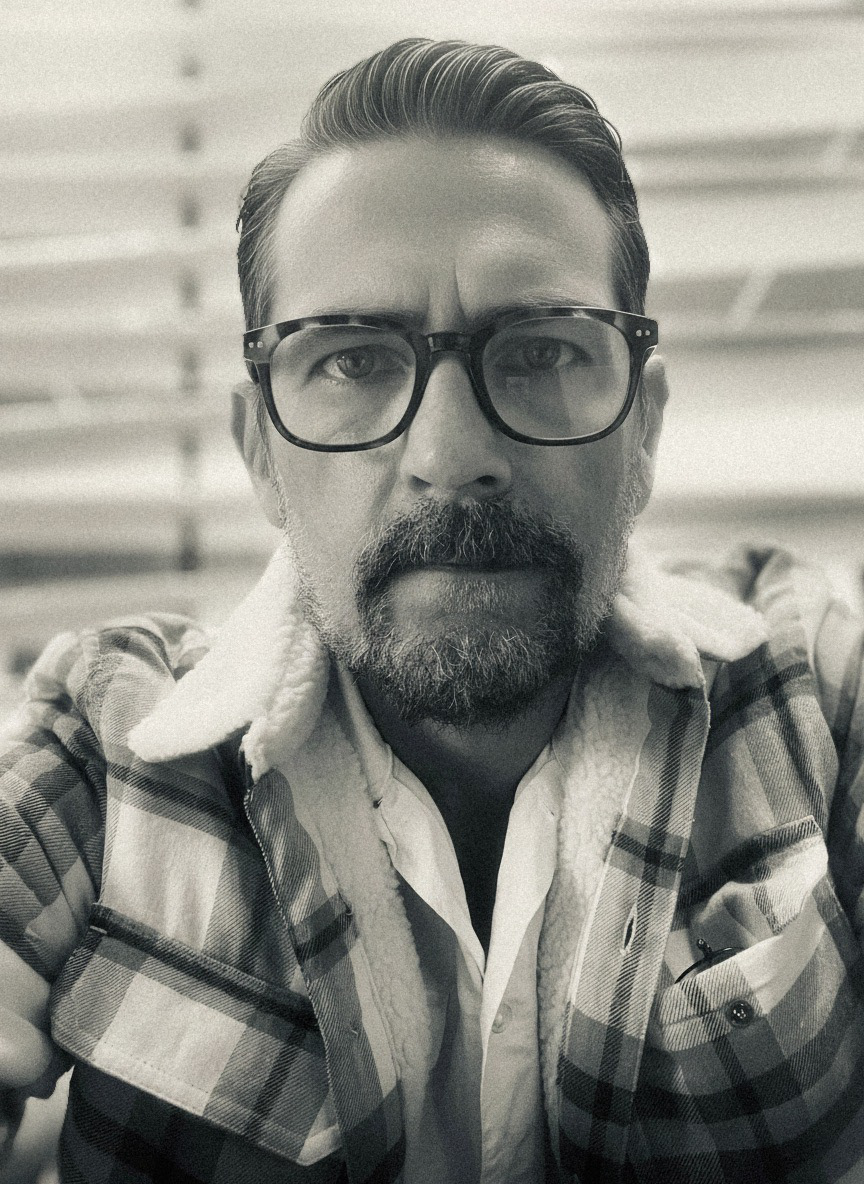
I am an autistic composer and photographer who translates the 'unspoken' into sound. My creative process is an exercise in Atmospheric Realism: a search for the frequency of a moment, whether it is a walk through a fog-shrouded wood or the weight of a forgotten story.
Born from a need to exorcise internal shadows through craft, my work utilizes a meticulous, hand-crafted workflow. I blend the raw, tactile humanity of live acoustic instruments with proprietary digital synthesis and the expansive power of the orchestra.
I believe that a great score should look like a frame and an image should sound like a note. Whether building the conceptual foundations for a new world or providing the emotional glue for a visual narrative, I aim to create an experience as raw, authentic, and visceral as the human condition itself.
Some of my latest works:
On Atmospheric Realism and the Logic of the Unspoken
For as long as I can remember, the world has presented itself to me as a series of patterns and intervals rather than words. As an autistic creator, I now process the landscape through a sensory logic that is difficult to verbalize; it is a feeling of inherent symmetry and frequency that exists in the space between things. I began my journey at the piano at a very young age, teaching myself the language of music theory because (I know it now) it felt more honest than the social noise surrounding me. By the early 1990s, this obsession evolved into my first home studio, a mechanical laboratory built around the Atari 520ST and Cubase, where I pushed maxed-out Akai s1000 samplers and, at the time, mostly discarded Juno synths to find the specific sounds I heard in my head. I was a "Renaissance Man" in the making, but I was also learning a dangerous skill: masking.
There was a long period where the music almost stopped. For years, I funneled my energy into fitting into a neurotypical world, an exhausting performance that eventually led to a catastrophic life collapse. The silence of those years wasn't the "cinematic silence" I work with now; it was a void born of displacement. I eventually found my way back through the lens and the keyboard, using photography and composition as a combined therapy to exorcise the shadows of depression. I traded the rack gear of my youth for the fluidity of Logic Pro on Mac and its portability of the iPad, discovering that the tools didn't matter as much as the truth they allowed me to express. I realized then that a great score should look like a frame, and an image should sound like a note: a philosophy I call Atmospheric Realism.
My workflow is now an obsessive attempt to capture the specific, almost unreachable frequencies of my internal landscape. I am never satisfied with "out of the box" sounds because they rarely math the sound in my head for the story I am trying to tell. I utilize a three-pillar hybrid approach because one medium is never enough: the piano provides the tactile, human grounding of my early education; custom synthesis allows me to tweak and warp digital textures until they match the specific logic of my mind; and the orchestra provides a sense of grand scale that can express both immense power and fragile weakness at the same time. I need this friction between the organic and the synthetic to build the sonic DNA for worlds that need to be felt.
This is why I am drawn to building fictional worlds, whether it is the brutal beauty of Sengoku Japan or the desperate exodus of a dying civilization. These spaces feel more real to me than the "real world" ever has. Building a world from scratch is a practical exercise in honesty; it allows me to define the atmosphere, the rules, and the ghosts of a place before the first note is even played. In these worlds, I can be content with silence, because I know that true silence doesn't exist. Just as a vacuum is alive with chaotic quantum fluctuations, musical silence is a player in itself: a heavy, breathing space where the unspoken finally takes shape. My goal is not to stay in the dark, but to stay true to myself, using the industrial grit and symphonic scale of my work to find the light at the very edge of the shadow.